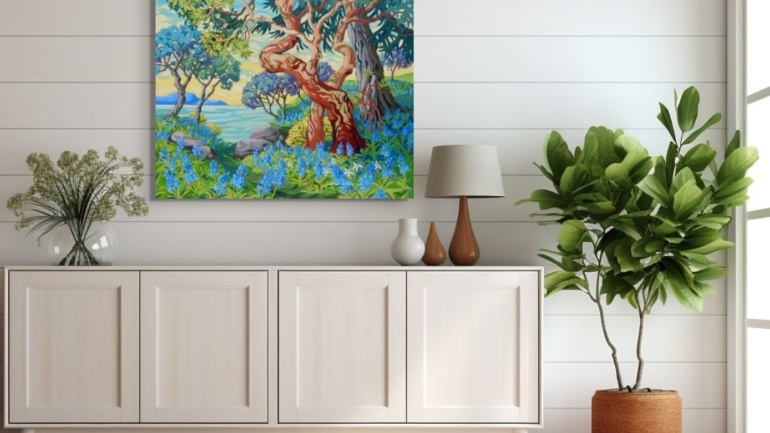
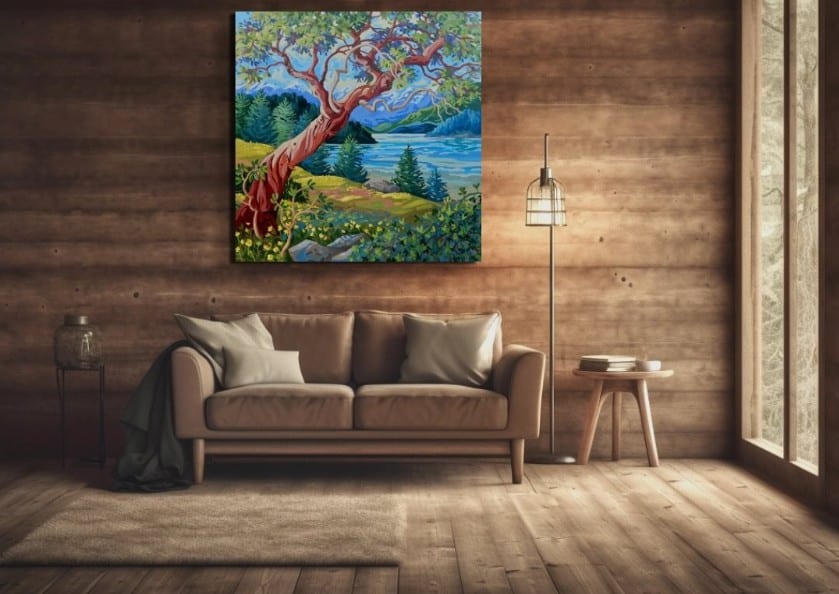
The idea of transforming a home through art is often described as a visual upgrade. In contemporary practice, transformation occurs less through appearance than through presence. When an artwork enters a domestic space, it carries the artist’s authorship, intent, and cultural context into the everyday, into routine, light, memory, and repeated encounter. Choosing art for the home is therefore not a question of enhancement or stylistic compatibility. It is a long-term relationship with a work that must sustain its complexity outside institutional framing, asserting meaning over time rather than resolving into the background.
Choosing art for the home is therefore not a question of enhancement or stylistic compatibility. Each work carries the artist’s intent, research, and authorship, shaped by specific social and cultural contexts. These qualities do not recede in domestic settings. On the contrary, the absence of institutional framing requires the work to sustain its complexity and autonomy within everyday life.
Collectors who live with art over extended periods encounter this transformation gradually. Artworks do not resolve a space; they remain active within it, asserting meaning through repetition, time, and sustained proximity. In this sense, transformation is not immediate or decorative, but durational, emerging through long-term engagement in which art retains its status as art, rather than being absorbed into its surroundings.
1. Encounters and Sightlines: Living with Art
Your home is not a blank canvas awaiting decoration; it is a network of lived perspectives. You encounter artwork at different times of day and from different angles: in passing on your way to the kitchen, caught in morning light, or quietly at night. Ian Tan Gallery notes that art lovers feel as if they’re exploring an anthology of stories encased within each piece. Those repeated encounters create a relationship with a work’s narrative and authorship rather than with its decorative effect.
Understanding how you move through a space helps you imagine what kind of attention a piece will invite. Instead of treating a painting as a finishing touch for a room function, think about where you want to place it, at the end of a corridor, across a long sightline, or at the moment when sunrise or dusk touches the surface. This is about making room for the artwork’s presence, not about matching a colour scheme or filling a blank wall. Each piece at Ian Tan Gallery is chosen for its ability to stand alone as an authored cultural work; the gallery’s curated roster of artists offers unique viewpoints that mirror the complexity and beauty of contemporary life. When you bring one of these works into your home, you invite that viewpoint to become part of your daily routine.

2. Developing Your Eye: Connecting with Artists and Stories
Many people approach art collecting as a matter of matching styles, but serious collecting develops through curiosity and repeated return. Supporting Canadian artists and nurturing local stories is at the heart of Ian Tan Gallery’s mission. When you visit the gallery or browse its collection, pay attention to which ideas, images, or materials keep drawing you back. Those threads often lead to artists whose works remain alive long after the first encounter.
Building your eye means getting to know the artists themselves, their techniques, influences, and why they make the decisions they do. When you purchase an original painting, you’re not just adding an accessory; you’re making a statement and telling a story. Ian Tan Gallery fosters this connection between artists and the community, offering personalized consultations and in‑depth insights. Curatorial guidance helps collectors understand how a specific piece relates to an artist’s broader practice, giving you context to live with the work over time.
An important question isn’t “What matches my sofa?” but “What can I live with and continue to learn from?” Works that reveal themselves slowly—through subtle surfaces, thoughtful composition or evocative subject matter- are often the ones that remain compelling as life shifts around them. Rather than following trends, choose pieces that resonate with your values and experiences; over time, these works will become part of your own story.
3. Colour as Authorship: Atmosphere, Memory, and Material Decision
In contemporary art, colour is an intentional decision loaded with cultural reference, emotional temperature, and material consequence; it is not an accessory to be matched with a room. Art has a remarkable ability to evoke powerful emotions and create a connection between the viewer and the artist’s vision. When you consider a painting’s palette, think about what the artist is conveying: memory, place, mood, and how those qualities might resonate with your own history or sense of place. You’re engaging with authorship, not coordinating décor.
Light and environment will influence how you perceive colour in your home. Natural light shifts across the day and across seasons, changing how pigments read and how surfaces register. A warm ochre may glow at dusk; a deep blue might recede in winter light. These changes become part of the work’s lived complexity, making it feel responsive rather than static. Instead of seeking perfect harmony, embrace the tension and contrast that make a piece feel alive. A painting that introduces unease, restraint, or ambiguity can keep a room visually awake, inviting you to engage with its subtleties over time.
Many artists represented at Ian Tan Gallery draw on the landscapes and cultures of Canada, using colour to express those connections. The gallery’s roster is diverse, ranging from atmospheric landscapes to abstract explorations—and each artist brings a distinct palette shaped by their experience. Exploring these choices can help you choose a work whose colours carry meaning beyond aesthetics.
4. Light, Reflection, and Placement as Conditions of Looking
Lighting and placement are not decorative afterthoughts; they are part of how an artwork can be seen and preserved. Harsh light or glare can flatten surfaces, while careful illumination reveals brushwork and depth. Working with your gallery to understand the material needs of a piece, how it should be framed, and what kind of light it requires ensures that you experience the work as the artist intended and protects it for years to come.
Natural light often offers the most rewarding conditions, but direct sun can damage pigments and paper. Galleries like Ian Tan provide practical guidance on positioning pieces in relation to windows, heat sources, and environmental fluctuations. This is part of responsible stewardship; living with art is not simply about display but about caring for the work so that its presence endures.
Framing is also part of this stewardship. A frame is not a decorative flourish but a boundary and a form of protection. Good framing respects the artwork’s materials and supports its visual logic, allowing it to breathe and remain stable. By attending to these details, you honour the artist’s labour and ensure that the work remains vibrant in your home.
5. Let the Work Keep Its Autonomy
In a domestic setting, the objects around an artwork can either support its presence or compete with it. The goal is to give the work space to assert its own identity, free from staging or over‑determination. Many collectors discover that the most powerful installations are often the simplest: a painting hung with room to breathe, a sculpture placed where you encounter it daily. Respecting a work’s autonomy, its capacity to speak on its own terms, reinforces that you are living with a cultural object, not decorating around a prop. Ian Tan Gallery’s team values each client relationship and focuses on helping collectors make choices that will enrich their collections and lives. This collaborative approach encourages you to trust the work’s autonomy while integrating it into your home’s daily rhythm.
6. How Contemporary Paintings Hold Presence in the Home Over the Years
1. Lesley Anderson’s
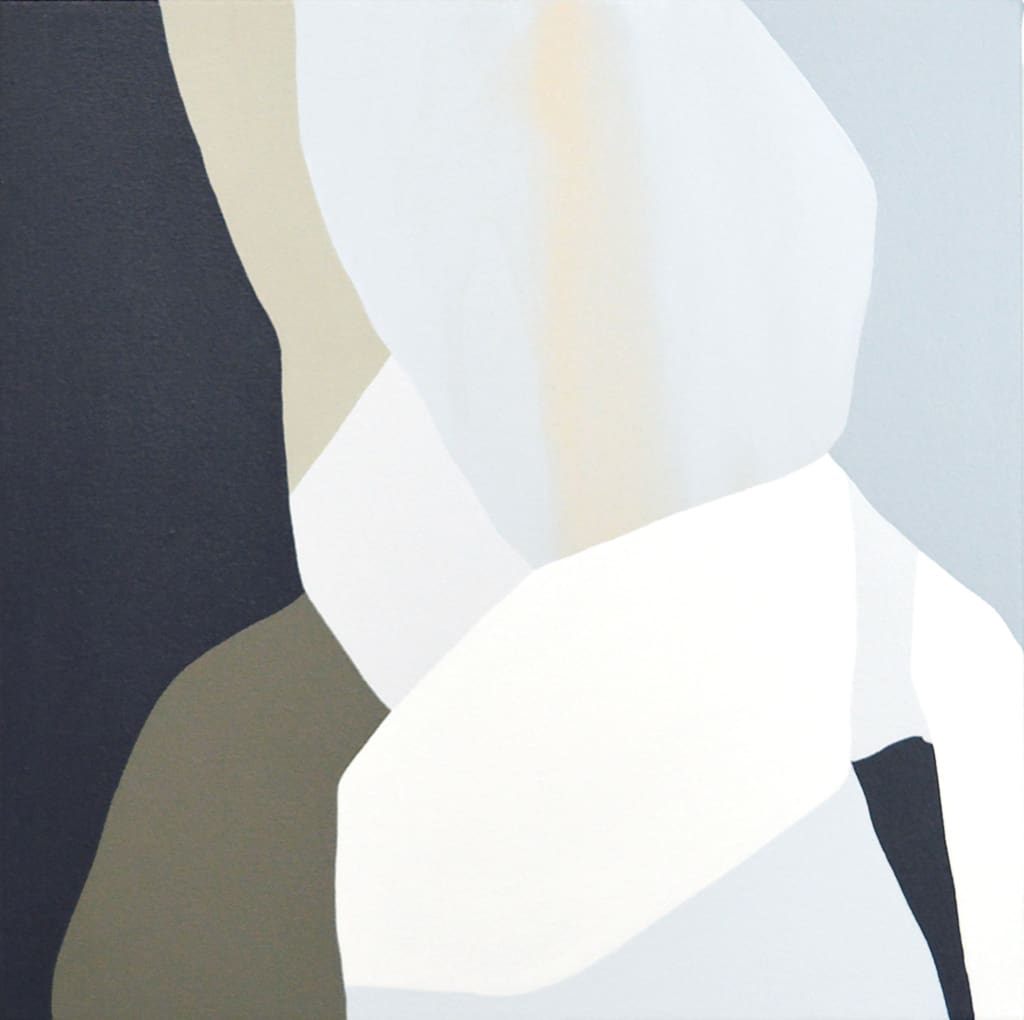
Lesley Anderson’s work shows why living with art is different from simply decorating. Her paintings are rooted in process and authorship, developed through an active studio practice that moves between drawing, painting, and cut, painted papers. She builds an inventory of marks, colours, and forms, then recombines them into compositions where structure and improvisation sit in deliberate tension.
In Small and Wild (2020) (acrylic on canvas, 16″ × 16″), layered shapes and softened colour fields create a calm balance that reveals more over time. Close up, you notice intentional edges and transitions; from a distance, it resolves into a quiet whole. Works of this scale often suit spaces you move through or return to daily, like a reading corner, stair landing, hallway, or study. If you’d like to see how this piece fits within Anderson’s broader practice, and how it could be placed and lived within your home, we’re happy to guide you.
2. Tatiana Anisimova
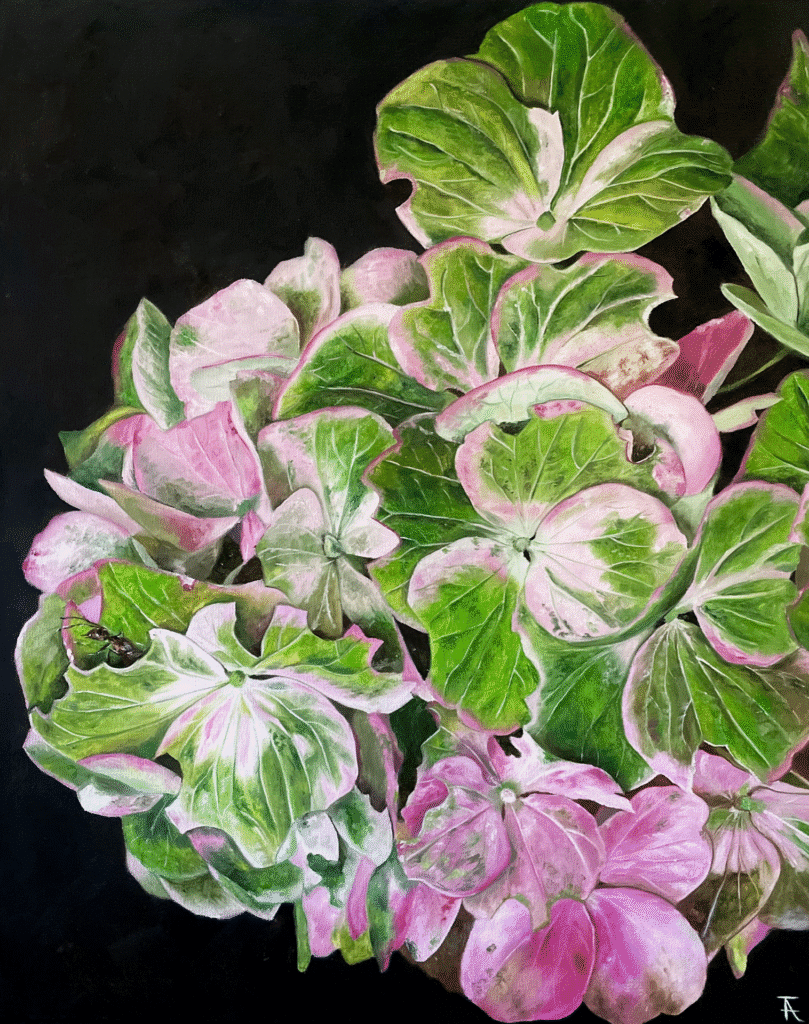
Tatiana Anisimova treats florals as lived experience, grounded in close observation and a precise, patient practice shaped by her background in biology. Working in oil on dark grounds, she draws from her own photography to explore fragility, endurance, and renewal without sentimentality.
In Awakening (2025) (oil on canvas, 30″ × 24″), flowers surface from velvet black with suspended intensity, luminous greens and pinks that reveal more in tone and texture over time.
Collectors often place it where quiet attention is possible, bedrooms, sitting rooms, or light-shifting transitional spaces, so the work can accompany daily life without becoming décor.
3. Gary Aylward
Gary Aylward approaches the Canadian landscape as a force, not scenery. In Black Ledge Undertow (2024) (oil on canvas, 44″ × 65.5″), he uses Renaissance-informed layering and glazes to build controlled light, shifting translucence, and high-resolution detail, placing the work in dialogue with traditions of the sublime and nature’s scale and volatility.
What it offers in a home is an encounter: wave energy folding and pulling into undertow, with surfaces that reveal more the longer you look, foam patterns, green-blue depth, and the weight of rock. Given its scale, it suits spaces with long sightlines where you can view it from a distance and approach gradually, such as a main living area, stair landing, or an opening hallway. It isn’t meant to “finish” a room, but to support a lasting relationship with landscape and Aylward’s practice over time.

7. How Domestic Spaces Change the Way Art Is Experienced
A home offers multiple kinds of encounters. In communal spaces, artworks become part of shared life, seen in conversation, noticed in passing, returned to while hosting or gathering. In private rooms, the relationship can become more intimate: repeated viewing from close range, sustained attention, and quiet familiarity with surface and detail. Transitional spaces operate differently again. Here, art is encountered episodically, glimpsed, re-seen, and re-understood in fragments, often shaped by shifting light.
Collectors often discover that the “best place” for a work is not where it looks most agreeable, but where it remains most alive, where it continues to reveal itself through daily rhythm rather than being absorbed into the background. Over time, placement becomes less about certainty and more about listening: noticing how a work behaves in a space, and allowing it to establish its own kind of presence.
8. Why Living With Art Is Different From Decorating With Art
Living with art in the home begins with the work itself, its authorship, the artist’s intent, and the wider practice it belongs to. Rather than treating a piece as something to “fit” a room, this approach asks what the artwork is doing: what ideas it holds, what material decisions shape it, and what cultural context it sits within.
For collectors, this shift matters because it supports long-term engagement. A work is chosen not for immediate visual agreement, but for its capacity to remain compelling through repeated encounters, across changing light, daily routines, and different ways of seeing over time.
This is also where working with a gallery becomes central. Curatorial guidance helps collectors understand how a specific piece relates to an artist’s broader practice, provides the context needed to collect with intention, and supports practical decisions, placement, sightlines, and care, so the work can be experienced fully in the home.
Conclusion
Choosing the right art for your home is more than an aesthetic decision; it influences the atmosphere you live in every day, shaping mood, energy, and how a space functions. The right artwork adds visual interest, supports relaxation where you need it, and reflects what matters to you. Over time, it becomes part of your routines and conversations, helping your home feel intentional rather than simply styled.
Approaching art through artistic intent, authorship, and cultural context makes the experience deeper and more lasting. You’re not just selecting an image for a wall, you’re engaging with an artist’s perspective and a work that holds meaning beyond trends. In a city like Vancouver, collecting contemporary art can also be a way to connect with living culture and support artists working today, whether your taste leans toward abstract texture, minimal composition, or expressive figurative work.
At Ian Tan Gallery, we support homeowners, designers, and collectors with a thoughtful, practical approach to living with art. We offer curatorial guidance, personalized recommendations, and visual mock-ups to help you evaluate scale, placement, and cohesion before you commit, so decisions are informed, not rushed. Whether you’re choosing one defining piece or building a collection over time, the goal is a home where art is truly present: experienced daily, returned to often, and understood more deeply with time.